
That simple question lies at the heart of many successful deep-tech innovations. Moving a breakthrough from the lab into the world is one of the most demanding challenges in modern innovation. Unlike consumer apps or incremental software updates, deep tech begins with years of scientific discovery, uncertain feasibility, and often no clear customer waiting on the other end.
The journey isn’t just about building a product. It’s about building belief.
The partnerships behind the icons
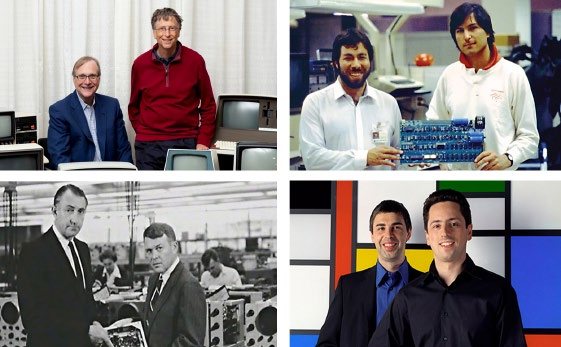
Some of the most iconic innovations of the past century were born from this kind of pairing. William Hewlett and David Packard built HP by combining technical brilliance with operational savvy. Steve Wozniak and Steve Jobs launched Apple by uniting engineering genius with marketing vision. Sergey Brin and Larry Page brought Google to life through deep algorithmic innovation and bold ambition. Paul Allen and Bill Gates formed Microsoft by pairing systems-level technical skill with unmatched commercial focus. In Japan, Sony was shaped by Masaru Ibuka, the technologist and product visionary, and Akio Morita, the bold global marketer who turned Sony into a household name. Even Tesla’s early trajectory reflects the dynamic: Martin Eberhard provided the founding technology while Elon Musk took on the role of visionary market shaper. These weren’t solo efforts. They were collaborations between invention and execution.
From the research model to the commercial model

This reflects a broader shift in how innovation is created and scaled. In the traditional research model, success is measured by technological capability. Progress tends to be incremental, and while scientific breakthroughs are celebrated they are rarely tied to immediate application. Risk aversion dominates, with program management steering development slowly and conservatively. Albert Einstein is emblematic of that model: the solitary genius advancing the frontiers of knowledge, unconcerned with whether his insights lead to product or market impact.
But the world has changed. In the commercial innovation model, success is measured by value proposition and impact. It demands interdisciplinary teams, bold vision, and a protected space for experimentation and failure. It values speed, market relevance and storytelling. Steve Jobs personified this model — a relentless innovator who translated deep technologies into emotionally resonant, commercially transformative products.
Two roles, one outcome
The hacker
The technologist — the person who understands the science at a fundamental level and can turn research into real-world applications. Whether the innovation comes from advanced materials, AI algorithms, novel hardware or unconventional architectures, the hacker translates a theory or a lab result into a prototype and eventually a product. More importantly, they know what is technically possible, where the limits lie, and how to rapidly experiment and solve problems others might not even recognise.
The hustler
The commercial catalyst — the individual who shapes the story, builds belief in others, and drives momentum. Where markets are unformed and products unproven, the hustler translates complexity into clarity. They raise capital, internally or externally, while the technology is still being developed; they identify early customers or partners willing to take a chance; and they create the conditions for adoption at scale.
Invention — the act of creating something new — can often happen within the mind and hands of a single technical expert. True innovation requires a broader set of skills. It demands an understanding of markets, customers, timing and strategy. It’s not just about building the thing. It’s about making it matter.
In a large company, the hustler is a visionary advocate
In large enterprises the hustler isn’t a salesperson or a project sponsor. They are a visionary advocate: someone who brings domain expertise, identifies with customer needs, and has the leadership to pull people from across the organization into alignment. Unlike a typical project lead, the visionary advocate champions the charge rather than managing a roadmap — actively clearing the path, overcoming internal friction, navigating bureaucracy, and addressing challenges spanning funding, politics, talent and market entry. They don’t just keep the train on the tracks. They decide where the track should go and get others to follow.
Consider a Tier 1 automotive supplier whose R&D team develops a novel bio-based material or a next-generation lightweight composite. The innovation is real, but the material’s performance and cost profile may be better suited to a completely different sector — aerospace, say, where lightweighting is mission-critical. At that point R&D may turn to internal sales or business development for help exploring the new direction, and find little traction. Those groups are focused on short-term revenue in their current verticals, with little time or incentive to explore unfamiliar markets. Worse, they may lack the expertise, language or network to navigate aerospace at all. This is precisely where the absence of a dedicated hustler inside R&D becomes a growth bottleneck. Without someone whose role is to scout markets, tell the story and drive initial traction, promising technologies get quietly shelved or prematurely killed.
Make it intentional
Many successful companies already support the hacker and hustler dynamic informally, through internal ventures, advanced innovation teams or incubation programs. But making it intentional — embedding both technical and commercial ownership from the earliest stages of development — dramatically increases the odds of market success. It also aligns with how investors, partners and customers increasingly expect to engage: not just with a technology, but with a clear, viable path to impact.
The hacker ensures that what is being promised is technically sound. The hustler ensures that what is being built is meaningful, fundable and scalable. Together they form the foundation for translating deep-tech innovation into real-world transformation.
So — are you a hacker or a hustler? And more importantly: are you building both into your teams, your processes and your innovation strategy? If you want to turn research into relevance at scale, you will need both.
One to build the rocket, and one to sell the ticket.
Get a complimentary innovation assessment
We’ll help you align your internal teams around the advance, the need, and the goal.
Let’s Connect→